Parenting & Family · June 9, 2007 · Rachael
Le Grand David, Through a Girl’s Eyes
This year (2007) marks the 30th anniversary of what is officially called “Marco The Magi’s Production of ‘Le Grand David and his own Spectacular Magic Company,’” a show that is cited in The Guiness Book of World Records as the longest-running stage magic production in the world. I was part of that production as a child and into my early teens, from its beginnings in 1976 until 1984. These are some of my recollections.
The show itself was the creation of Cesareo Pelaez, otherwise known as Marco the Magi. Cesareo was born in Cuba and came to the U.S. in his twenties, eventually taking a job teaching psychology at Salem State College. It was there that he met many of the young people who would later become part of the theater troupe. Cesareo was a very charismatic person, extremely bright, quick, and light on his feet (he pranced in and out of magic tricks in a leotard into his sixties). He also had a strong intuitive grasp of character, which he used to his advantage. One of my strongest memories is of him sitting in a chair in the front lobby and swearing a blue streak at some cast member or another for what seemed an arbitrary reason. I always felt like the swear words must have meant less to him because they weren’t in his native language. With children, like me, he was always kind.
I came into the circle of Cesareo Pelaez by birth, rather than by calling. In fact I was born at Cumbres, a spiritual growth center in Dublin, New Hampshire, founded and run by Cesareo and his early crew, in 1969, and funded by (among others) business school friends of my father’s. That group kept together after the closing of Cumbres in 1971, living near Cesareo in various metro Boston and North Shore locations and studying the teaching of Georges Ivanovich Gurdjieff. My own family moved seven times before I was seven. Somewhere in there, my father completed business school, and got a job in insurance. My brother Alex was born in 1972.
In 1976, Cesareo decided that the group should purchase an old vaudeville theater in Beverly, Massachusetts, called The Cabot Theater: they would restore it, start showing classic (second run) films, and put on a stage magic production. Apparently he had seen Fu Manchu in Cuba and had dreamed of mounting a similar spectacle. Very few members of the group had any particular interest in theater, but The Cabot would be a spiritual practice, a group effort. The purchase price was $110,000. 18 couples and individuals put in $10,000 each for purchase and restoration.
Early on, the women in the company used the basement of our rental house in Hamilton, MA (with black and white linoleum tile floor and a wall of mirrors) for tap dance rehearsals. We took a trip to Lowell to the sewing factory of the most entrepreneurial member of the group, Tom Shields, to sew the immense gold-colored “fire curtain.” The back yard of the house my parents purchased in 1978, the year my sister Natasha was born, served as a dyeing place for the tie-dye curtain. Later, our backyard was home to a handful of white Peking Ducks, cared for by my father, who appeared and then disappeared in one of the acts. They were terrorized (and worse) by local dogs, pecking, and excessive heat. Then there were numerous trips to Chinatown (to North End Fabrics and New England Textile, both of which closed during the last ten years) to purchase glittery fabrics of all sorts. And trips to Flea Markets in Salem for cheap costume jewelry.
As far as I can recall, my parents spent every weekday night in those early years at the theater. My father had his own insurance business, first out of our house, and then in an office near by. He would often get up at 4 or 5 to work then join us for breakfast at 7. Mom took care of Alex and me by day. By 5 in the evening, my parents would be off to the theater and us with a babysitter.
Dad was the lead carpenter (a skill he had learned from his father, Warren, who headed up Burger Construction in Iowa City with his brother, Dick) building all of the illusions with a group of men. Later, these were ornately painted by Rick Heath. Sears had an excellent return policy at that time and I think that several worn-out tools were returned for new ones. My mother, in her turn, was the head seamstress (a skill she had learned from her mother in her childhood and adolescence also in Iowa City), sewing hundreds of costumes with a group of other women on some industrial sewing machines which, I think, came with the building.
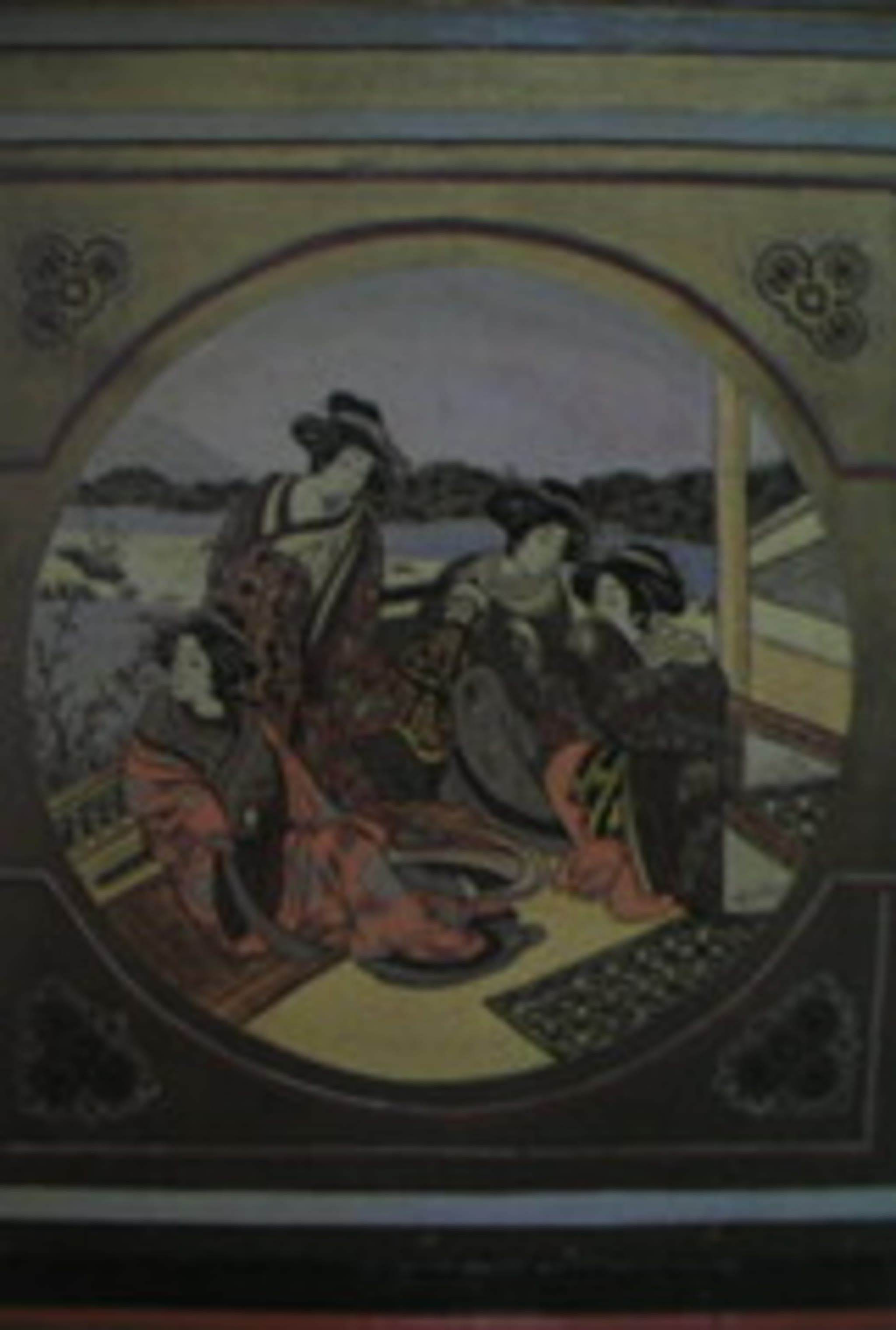
Detail of painting on one of the tricks, likely painted by Rick Heath.
My brother and I watched a great numbers of movies in our early youth, both excellent (24 viewings of Brother Son, Sister Moon, a hagiography of Saint Francis of Assisi by Franco Zepherelli) and inappropriate (Cabaret with Liza Minelli and Psycho). I can only assume that the Cabot movies were also a babysitter for us in the evenings, while my parents built or sewed or ushered or worked the concession stand in the sumptuous upper lobby.
Saturday mornings were for rehearsal. Sunday mornings my parents went to the theater to set up for the Magic Show and participate in group reading and meditation. Those mornings I was in loosely looking after a group of Magic Show children: Maria and Dominic DiSanto, Leala and David Sears, and my own siblings. 3:00 was the start of the afternoon show, which went until about 5:30, and the evening show started at 8:00. Between shows we’d go out to eat at Maria’s Pizza (directly across the street from the theater) or order a Pu-Pu Platter at the latest local Chinese Restaurant. By the end of the evening show, I’d be falling asleep while sitting upright on a table back stage, waiting to go on. We were in bed by 11:30 on a school night.
Summer times were the occasion for extra runs of shows, sometimes on Wednesday, Thursday, Friday, and Saturday evenings, followed by the two Sunday shows. No “days off” were allowed for any member of the cast whether for school events, family obligations, or funerals. We saw our extended family in Iowa for one week each summer and I remember having to fly back early for the show during a “Southern Trip” with my school.
Alex and I spent a lot of time with Seth and Kyra, Lyn and Leslie Bartlett’s kids. Seth was one of the stars of the show. He was a year younger than me and a year older than Alex. He loved fart jokes and was fond of lines like, “He who said it let it” and “He who denied it supplied it.” Kyra was about four years younger than me. We four delighted in calling each other “Lizard Breath” and “Mama J”. I’m not sure why. The Bartletts lived in a rental house on a rocky cliff in Beverly. We played Barbie dolls and ate a lot of saltines. We took trips to the beach in Rockport with our mothers and had adventures reading “marijuana” (mara-joo-na to us) grafittied on a rock face and jumping off impossibly high, sharp boulders into the cold salt water. We scraped our legs and ate slushies and ice cream so fast that we got cold headaches. Lyn (née Moon) had attended Pine Manor college. Leslie, her husband, was a juggler in the show. My middle name comes from Lyn, and Cesareo was my Godfather, and the Godfather of my brother and my sister as well.
Aside from the Bartletts, we spent time with Rebecca and Daniel Shuman. Rebecca and I were in the show together and she was a year younger than me. Her father, Bob, was a psychologist and the family lived in Marblehead. They left the show rather early. In addition, we were friendly with Lou and Susan DiSanto and their children Dominic, Maria (my sister’s age and still a close friend) and, later on, their son Michael. Susan was Irish Catholic, incredibly warm, a great seamstress and cook, and had long hair and long skirts (this was the ‘70s). Her husband Lou was Italian American and told hilarious stories about teaching driver’s ed in Harvard Square. Both had met Cesareo at Salem State. Tom and Elnora Sears and their children, Leala and David, were also part of our family circle. All were gentle people, light in stature and hair color. Tom built flutes for a living and played beautifully. I occasionally babysat for Leala and David. All of these social ties formed from the shared involvement in the theater and the fact that us children were roughly the same age. I think that these ties were discouraged rather than encouraged, though, a kind of clandestine carrying-on that might be seen as distracting from “the work”. In the end, most of our time was spent at the show anyway.
The Magic Show itself was a stage extravaganza lasting 2 ½ hours, including intermission. Interspersed with tricks (most of them technically simple and based on distraction or theatrics) were opulent costumes, curtains, manufactured fog, animal appearances, tap-dancing, singing, and comedy. At its height, there were more than 60 cast members appearing on stage for each show. The stars were Cesareo, David and Seth.
Cover of the 500th Performance Brochure, dated January 18th 1981. The author is at left, standing.
I had, as I recall, 5 appearances during the show. The first was at the beginning, where I descended, with other women, from a Pagoda-like structure, attired in a heavy, store-bought Kimono, obi, and black bun wig while holding a lantern between my two hands. The second was a number where I appeared with Rebecca Shuman (above) in a long sequined ruffled dress with arm wings and rosettes to retrieve various items (scarves?) that had appeared from a box. I would enter, take the scarf, pause, look back, then exit. Always smile.
After intermission, I appeared as a street-sweeper, in a burlap dress and red satin apron trimmed with yellow sequins, a broom trailing behind me. This number involving a line of “broom dancers” (the adult women) breaking through a ribbon curtain (created by my mother and friends), to witness a levitation by Cesareo of David, a cripple clad in the fully sequined pant suit. (This levitation number was one of the few tricks that was at all sophisticated mechanically). Later on, I came on stage in a snow-white style cape in a double-knit fabric with a huge, metal-framed stand up collar to retrieve a dove that had just appeared from a glass, black-bottomed box held by David. Then there was the Pagoda, the finale, where I came on, bowed, and processed out to the lobby with the entire cast to form a receiving line for the guests.
Despite their involvement as founding members of the show, my parents didn’t spend much time on stage. My mother came on as a “butterfly lady” at some point, and my Dad played the trumpet and was part of the barbershop singers. My brother was as involved as I was with the show in the early years, and stayed on after me to participate in the Larcom show under the tutelage of the talented Professor Besco (Bob Murphy) who is now, among other things, a serious actor and business owner. My sister was part of a group of younger children who were trotted out during the light box act but spent most of their time during the show at the “Blue House”, a property purchased (by the corporation, or some of its members) in the ‘80s which housed some of the cast members, including Avrom, Ann, and Ellen, and which was used for the care of a great number of young children during the show.
Seth with “The Cats.” Clockwise from top: Seth Bartlett, Kristen Schneider, Elizabeth Feldman, David Sears, Leala Sears, Dominic DiSanto, and Alexander Burger (the author’s brother).
The actual on-stage part of the show was the least interesting part for me. Though we were close in age, I never envied Seth his stardom (it never even occurred to me to do so). David (the other star) was tender and very young (I remember celebrating his 22nd birthday during the run of the show). Cesareo, of course, we’ve discussed. He orchestrated every step and made every decision.
More exciting for me were the back-stage goings-on: the transitions, at key moments, from one side of the stage to the other, running behind the curtain in the dark while a scene transpired in front, and the various places and people I was involved with while not on stage.
The women’s dressing room was a cramped, carpeted room crammed with smelly costumes and accessed by a steep stairway one floor above the stage, on stage right. The women stood against one wall with a high, face-level mirror to dress for the show, applying foundation, fake eyelashes, rouge, eye shadow, copious amounts of hairspray, various drugstore perfumes (L’Air Du Temps being a big favorite) and wigs. I wore the same kind of make-up, and remember how it felt like a mask on my face, how hard it was to get the line of glue straight for the lashes, and how the Clinique soap of my mother’s that I used to take it off stung my eyes.
I remember hearing snippets of the women’s conversation as they dressed. I sat in a corner, with my brother, I think, and some other children. How this one went from a C-cup to a triple E when she had her first child. Talk about the Pill and turning 30. These women were mostly younger than my mother (who would have been 31 when the show started), and many were unmarried. Their kindness to me is the most precious thing I take away from the show.
Perry MacIntosh (originally from Alabama, and a graduate of Smith College) bought me a Laura Ashley perfume that I loved for, I think, my 10th birthday. She lived with Lyn and Leslie Bartlett for a time (Seth and Kyra’s parents) and worked at Bandhauer’s Bakery in Beverly. Later she did very well in the publishing world, ending up at Harvard Business School Press, and she mentored me a bit in my college years and just after.
Clair Ayer (the sister-in-law of Edlita, the main tap dancer) would sit with my brother and me and some other children before the show and tell us long mystery stories that included bunnies and other animals of our choosing. Steve Ozahowski (“Oza” for short) took care of Rebecca and me in the Light Booth on Stage Left before our first number. Each week we’d love writing the name of a different flower with the date on a piece of masking tape that we’d stick up on a piece of plywood next to the booth. One day, the tape disappeared, certainly removed by someone who found this practice “unprofessional”. Steve was fun, young, and extremely good with us. He grew up in Lynn and was a high school teacher. He told us about piling eight people into a car to go to the drive-in. Much later on, Steve would marry my tap-dance teacher, Christine Abely.
Saturday morning I would tap dance on stage with the women. Edlita Ayer led that rehearsal. She, as I recall, had almost been a Rockette (she was good enough, but a tad too short). She was an excellent dancer and coached all of us through numerous exercises. Christine was the second in command of tap. After the rehearsal with all of the women, some of the girls (Rebecca, Kyra, sometimes Leala, and I) would go down to the basement of the main building and have a lesson with Christine. When that lesson was done, I had my own lesson. Christine would choreograph numbers for me and I’d learn more complicated steps. I performed once or twice for the company on New Year’s Eve.
Later on, my Saturday lesson was followed (or perhaps subsumed?) by a private tap session with Christine on the stage between performances on Sunday. After the show, we’d go to Christine’s apartment a few houses down from the theater (I think she shared this apartment with Katie MacNiff at the time) and have a tuna sandwich on wheat that she had prepared and then we’d go back to the theater and do our tap. The theater would be dark and quiet with just the two of us there. This was so much fun for me: to get to spend time with Christine, who was the sweetest most loving person I’d ever met; to hear about her life, her childhood, and college; and to learn to tap. I have no idea why I was afforded these lessons, since I didn’t even dance in the show until much later. When Steve and Christine started dating, probably around 1981, Cesareo decided that they should spend time together between the shows, so my special tap sessions ended.
I remember the moment, in the show, when I crossed over from being a child to being a woman. About age 13, I got a pair of high-heeled tap shoes (replacing my patent leather flats with 2 ½’’ nude heels) and I actually got to dance in the women’s tap line, bursting through the curtain at the beginning of the levitation number. About that same time, I was helping Steve Ozahowski pull up a curtain after a show. We were laughing. Cesareo came over and yelled at me (and Steve). Something about not being “professional”. It was very clear to me even then that this getting yelled at was part of my entry into adulthood. I left the show, anyway, when I went to France for a year just after I turned 14. Apparently my father was scared to death to tell Cesareo that I was leaving, and chose to bring it up at a time when Cesareo was feeling particularly guilty after a fight with him. “I didn’t ask”, my father said, “because the rule was, if you ask the teacher for advice, you have to take it.” When I returned, I attended the Sunday morning prep/teaching sessions, but they never made much sense to me. So I stopped.
The outside world appears to have received the theater and the show with a great deal of enthusiasm. Little wonder, perhaps. We created a something incredibly beautiful, as is perhaps possible when you have a strong central vision and the free labor of dozens of committed adults. Certainly nothing like this would have been possible within a more conventional financial arrangement.
My classes at school would come to the theater to see classic and french films (Jean de Fleurette, Cassablanca). The ticket prices were low, the films (mostly) family-friendly, the staff pleasant, and the theater, of course, was beautiful, with sumptuous carpeting and every inch of its gold leaf restored. The Magic Show was attended by young families, for birthday parties, and by tourists who came in on buses for Sunday afternoons, filling the 800-seat theater. Sunday evenings were a less popular time. Occasionally we performed for a dozen or so people.
Marco and David were warmly received by American Magic Circles. Famous TV and stage magicians of the time, Doug Henning and David Copperfield, visited the show. My family hosted a lovely 80-something English gentleman and designer of illusions named Eric Lewis who taught me to move a pendulum with my mind (occasionally) and liked his tea hot. Marco was honored by the Society of American Magicians, and served as National President from 1985-1986. In 1980, we appeared in Time Magazine (I’m pictured there too, in my “broom dress”, in the far right corner). We performed several times on the White House lawn for the “White House Easter Egg Roll” during Reagan’s first term.
About the same time we traveled to Hollywood to perform at the Beverly Wiltshire Hotel, an impossibly glamorous venue, for Cesareo to receive some kind of award. Christine wore an elegant white dress with a knot in front that she later wore for her wedding, and that night I learned that Rock Hudson had died. There, I remember visiting “The Magic Castle,” a freestanding museum/theater of magic which boasted a piano named Irma who would answer your questions with the song. We also attended a party at the home of one of the magicians, a castle-like home with huge gardens, bridges, and dark greenery where we played at night. We saw the stars on Hollywood Boulevard. That was my last trip to LA.
As a child growing up at The Cabot, nothing about this whole adventure seemed odd. I was happy to be surrounded by caring women (and a few men) who doted on me. What could be more fun? I also realize, in retrospect, that I was in an exceptional position. I was more or less the oldest girl in the cast; well behaved, studious, and restrained. I was one of the few children who had such a total immersion in the life of the theater, and I venture to say (from my brother’s experience) that hanging out with the women was a lot more fun than hanging out with the men. The women were, in certain ways, quite marginal to the central dynamics of the place, which involved Cesareo and the men. Like nuns in the Catholic church, this marginality gave them and (by extension) me a certain freedom that the men, a number of whom also lived with Cesareo in various locations near the theater, might not have had.
Looking back, I can appreciate the fact that my parents were involved in a substantial community endeavor outside of work and child rearing and that they were real spiritual seekers. How unusual, after all, to grow up in a place where when something needed to be done, four people leapt to do it. On the other hand, it’s clear to me that they were involved in a religious group that may or may not have contributed in any substantial way to the spiritual growth of either of them. My father sought spiritual fulfillment in a number of places, and my mother feels wounded by the experience to this day.
The cast members were always reading one or another book about Gurdjieff (whose teachings formed the spiritual core of the place). In my early twenties, I picked up a book by Ouspensky called In Search of the Miraculous which provides an overview of the Gurdjieff teaching. It talks about three spiritual paths: the way of the Yogi (the body), the way of the Monk (the mind), and the way of the Fakir (the emotions). The fourth way, that propounded by Gurdjieff, involves submitting your will to that of a person of higher spiritual level than your own. This submission must transcend everything, including family and marital relationship. I can only guess that the group believed that they were living the “fourth way” and that Cesareo was their enlightened leader.
An unusually insightful article by former Boston Globe writer Nathan Cobb in Smithsonian Magazine (November 1981) and entitled “The Wily Illusionist of Beverly, Massachusetts” puts it very well: “ . . . this enterprise could just has well have been Marco the Manager’s production of ‘David the Chef and his own Spectacular Seafood Restaurant.’ Or almost anything else.” What was essential to the group members and to Cesareo was not the content of what they were doing, but the spiritual and group work.
What if my parents had poured their spiritual and creative energies into more conventional charitable or cultural endeavors? Oddly enough, that’s what they’ve both done since: my mother works for a child care training and advocacy non-profit, and my father is in the middle of leading up the construction of a multi-million dollar building for the Rockport Chamber Music Festival. I seem the have inherited their maverick spirits and spiritual questing. I studied religion in college, and lived for a time with Benedictine nuns. I love renovating old buildings, designing and sewing clothing, and spent many years as a product manager for online communities. The man I married (an Indian, and also an exile) shares Cesareo’s charisma, intellect, and emotional acuity.
So end my recollections for the time being. In writing, I’ve hoped to honor many people who were involved with the Cabot Theater and who graced my life. In so doing, I’ve also attempted to write part of a history that is absent from most written accounts. I hope that others, should they feel so moved, will add their voices.
List of hand-written cast names from the 500th performance brochure dated January 18, 1981.